Your Malta Story · About Malta
Small island. Infinite stories.
Perched at the very heart of the Mediterranean, Malta packs 7,000 years of civilisation, sun-bleached limestone cities, and some of Europe's clearest waters into just 316 square kilometres.
Where every corner tells a story
"Malta is not a place you visit once. It is a place that stays with you — in the smell of sea salt on warm limestone, in the echo of bells across a baroque skyline, in the silence of a Neolithic temple older than the pyramids."
Lying at the geographic centre of the Mediterranean, the Maltese archipelago has been coveted, conquered, and celebrated by virtually every great civilisation in history — the Phoenicians, Romans, Arabs, Normans, Knights of St John, French, and British have all left their mark. The result is a living palimpsest: a tiny nation with a depth of culture, architecture, and character that would be remarkable in a country ten times its size.
Today, Malta is one of Europe's fastest-growing travel destinations. In 2025 it welcomed more than four million visitors for the first time ever, generating a record €3.9 billion in tourism revenue — yet the islands have somehow preserved an authenticity that mass tourism so often erodes. Grand Harbour still takes your breath away. The walled medieval city of Mdina still falls silent at dusk. The Blue Lagoon still glitters. Your Malta story is waiting.
7,000 years in the making
Few places on earth concentrate so much history into so little space. Malta's story is essentially the story of the Mediterranean — a stage upon which empires rose, clashed, and dissolved, each leaving an indelible layer of culture behind.
Malta has more historical monuments per square kilometre than almost anywhere else in the world.
5900 – 2500 BC · Neolithic period
Older than the pyramids
Malta's first settlers built the Ġgantija Temples on Gozo around 3600 BC — making them the oldest free-standing stone structures in the world, predating Stonehenge and the Egyptian pyramids. The Hal Saflieni Hypogeum, a subterranean necropolis carved from solid rock, is no less extraordinary. Both are UNESCO World Heritage Sites and remain in use as pilgrimage and awe destinations today.
870 – 1090 AD · Arab rule
The Arabic roots of Maltese
Arab rulers gave Malta a linguistic gift that endures: the Maltese language, unique in being the only Semitic language written in the Latin alphabet and an official language of the European Union. Phrases, place names, and even the laid-back island pace owe something to this chapter of the island's story.
1530 – 1798 · The Knights of St John
The age of the Knights
The Order of St John transformed Malta into one of the most formidable fortresses in the known world. Their greatest moment came in 1565 during the Great Siege, when a force of roughly 6,000 defenders held off an Ottoman fleet of 40,000 — an event that electrified Christian Europe and secured Malta's place in military legend. The Knights went on to build Valletta, now a UNESCO-listed city described by UNESCO itself as "one of the most concentrated historic areas in the world."
1800 – 1964 · British era
The George Cross island
Under British rule, Malta became a vital naval base. During World War II, the island endured years of relentless aerial bombardment — at one point sustaining more bomb tonnage per square kilometre than any other territory on earth — and yet refused to fall. In recognition of the population's extraordinary resilience, King George VI awarded the entire island the George Cross in 1942, the highest civilian decoration in the British honours system. You'll still see the George Cross on Malta's flag today.
1964 – present · Independence & the EU
A modern Mediterranean nation
Malta became an independent republic in 1974 and joined the European Union in 2004, adopting the euro in 2008. Today it is one of the EU's smallest but most dynamic member states — a hub for finance, tech, gaming, film production, and of course, tourism.
Three islands, three personalities
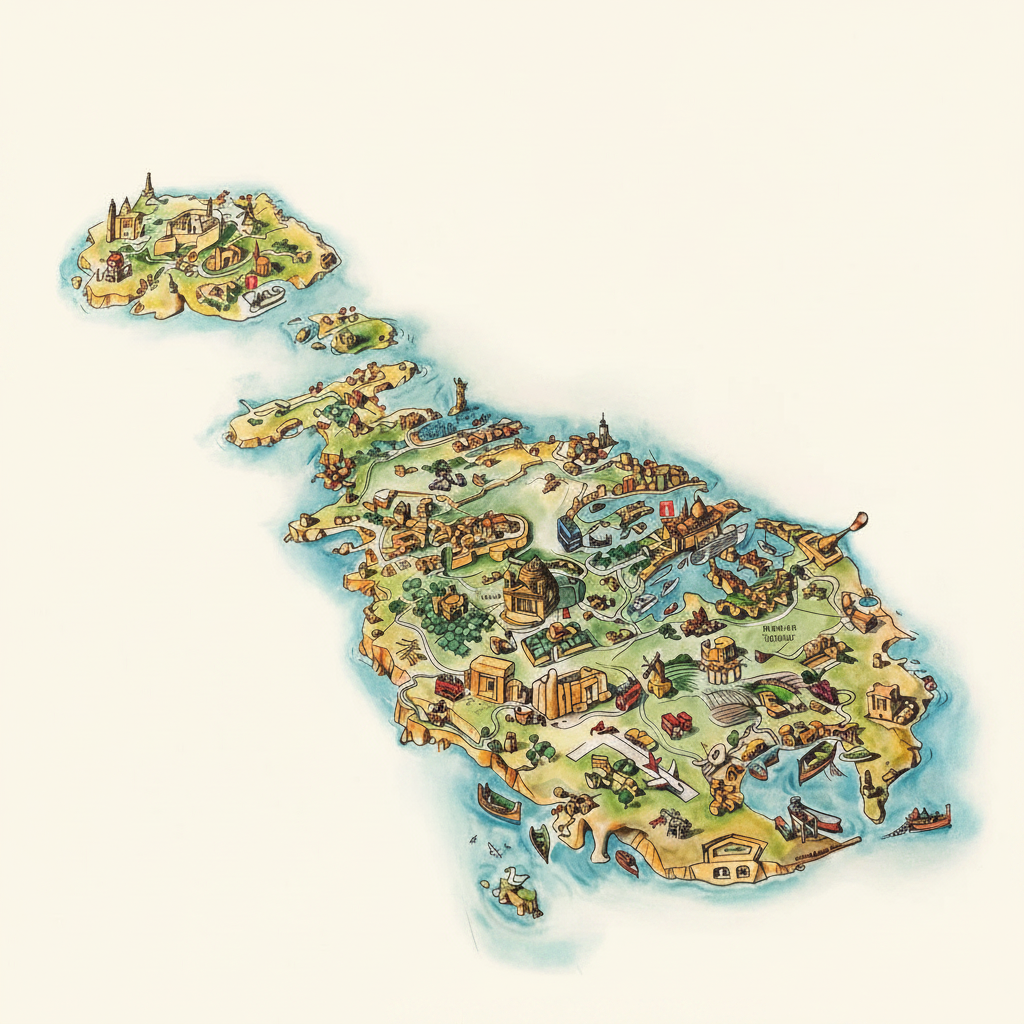
Malta is not one island but three inhabited ones, each with its own distinct character. Together they form an archipelago of extraordinary variety packed into a remarkably small footprint.
Malta
The main island is home to the capital Valletta — Europe's smallest capital city and a baroque masterpiece — as well as the medieval citadel of Mdina, the buzzing seaside town of St Julian's, the ancient harbour town of Birgu (Vittoriosa), and dramatic cliffs and swimming spots at places like Dingli and St Peter's Pool. Malta island is where history, nightlife, and culture converge.
Gozo
Gozo (Għawdex in Maltese) is Malta's quieter, greener sibling — a place of rolling valleys, traditional villages, world-class diving, and the iconic Azure Window site at Dwejra. With its slower pace and rugged landscapes, Gozo attracts those seeking an authentically rural Mediterranean experience. It's also home to the Ġgantija Temples, the oldest free-standing structures in the world.
Comino
Comino is just 3.5 square kilometres of rock, wildflowers, and jaw-dropping sea — and it needs nothing more. Almost car-free and permanently free of crowds (outside peak summer), it is home to the famous Blue Lagoon, whose surreal turquoise waters are among the most photographed in the Mediterranean. A day trip here is one of the defining experiences of any Malta holiday.
Reasons to make Malta your next trip
Valletta: Europe's smallest capital
A UNESCO World Heritage Site built by knights and baroque architects, Valletta rewards every step. The co-cathedral of St John's conceals Caravaggio's largest surviving painting. The Upper Barrakka Gardens offer one of the great harbour views in the world. And the city's grid of Renaissance streets is alive with galleries, restaurants, and cultural spaces.
Ancient temples older than Stonehenge
The Neolithic temples of Malta — Ħaġar Qim, Mnajdra, Tarxien, and Ġgantija — are some of the oldest buildings on the planet. Walking through them is a quietly humbling experience. The underground Hal Saflieni Hypogeum is carved to a depth of 12 metres and deserves a visit by anyone with a sense of wonder about human prehistory.
World-class diving and snorkelling
Malta's crystalline waters, dramatic underwater topography, and an abundance of World War II wrecks make it one of Europe's top dive destinations. Visibility can reach 30 metres or more, and the water temperature stays swimmable from April through November. Beginner divers, seasoned wreck explorers, and snorkellers all find exactly what they came for.
The Blue Lagoon, Comino
No photograph does it justice. The Blue Lagoon's shallow, sheltered waters glow with an almost unreal turquoise that shifts with the position of the sun. Take the early-morning ferry from Malta or Gozo to beat the summer crowds, pack a snorkel, and give yourself the morning. It is as close to paradise as the Mediterranean gets.
Mdina: the Silent City
Perched on a hilltop near the centre of Malta, the walled city of Mdina has been a human settlement for more than 4,000 years. Its narrow cobblestone streets, noble palaces, and baroque cathedral feel frozen in time — especially after dark, when the day-trippers have left and the city earns its nickname, the Silent City. It is one of the most atmospheric places in Europe.
Food, wine, and village life
Maltese cuisine is Mediterranean at its warmest — rabbit braised in wine and garlic (fenkata), fresh-caught lampuki (mahi-mahi), ħobż biż-żejt (crusty bread rubbed with tomato and drizzled with olive oil), and pastizzi (flaky savoury pastries eaten at any hour). Village feast days (festi) fill the squares with fireworks, brass bands, and long tables. This is a culture you experience through eating.
Everything you need to know
Malta is one of Europe's most accessible and visitor-friendly destinations. Here is everything you need to start planning your Malta story.
When to visit
Malta enjoys more than 300 days of sunshine per year. Summer (June–August) is hot and busy — perfect for beach days and nightlife. Spring (March–May) and autumn (September–November) offer ideal temperatures for sightseeing and hiking. Even winter brings mild weather and far fewer crowds.
Getting here
Malta International Airport is well-connected to over 100 destinations across Europe and beyond. Ryanair, Air Malta, easyJet, Wizz Air, Lufthansa, and many other carriers operate direct routes. Flight time from London is around 3 hours; from most European capitals, under 3.5 hours.
Getting around
Bus services cover the main island thoroughly and are very affordable. Ferries connect Malta to Gozo and Comino. Taxis and rideshare apps (eCabs, Bolt) are plentiful. Car hire is available if you prefer to explore at your own pace — just remember Malta drives on the left.
Language
English is an official language and is spoken everywhere. You will have no difficulty communicating, reading menus, or navigating the islands. Maltese, the national language, has roots in Arabic, Italian, and English — you may find yourself picking up a few words.
Visa & entry
Malta is a member of the European Union and the Schengen Area. EU and EEA citizens may enter with just a national ID card. Visitors from the UK, US, Canada, Australia, and many other countries can visit for up to 90 days without a visa. Check your country's requirements before travel.
Currency & costs
Malta uses the euro (€). It is generally more affordable than Western European destinations such as France, Spain's Balearics, or Italy's main cities, particularly for food, local transport, and accommodation outside peak season. ATMs are widely available; card payments are accepted almost everywhere.
Search hotels and flights
Compare stays and flights across Malta, Gozo and Comino. Your Malta Story earns a commission from bookings made through this widget, at no extra cost to you.
Your Malta Story
Your Malta story starts here
Whether you have a long weekend or two weeks, Malta will give you far more than you expect. Let us help you make it unforgettable.
Explore stories