

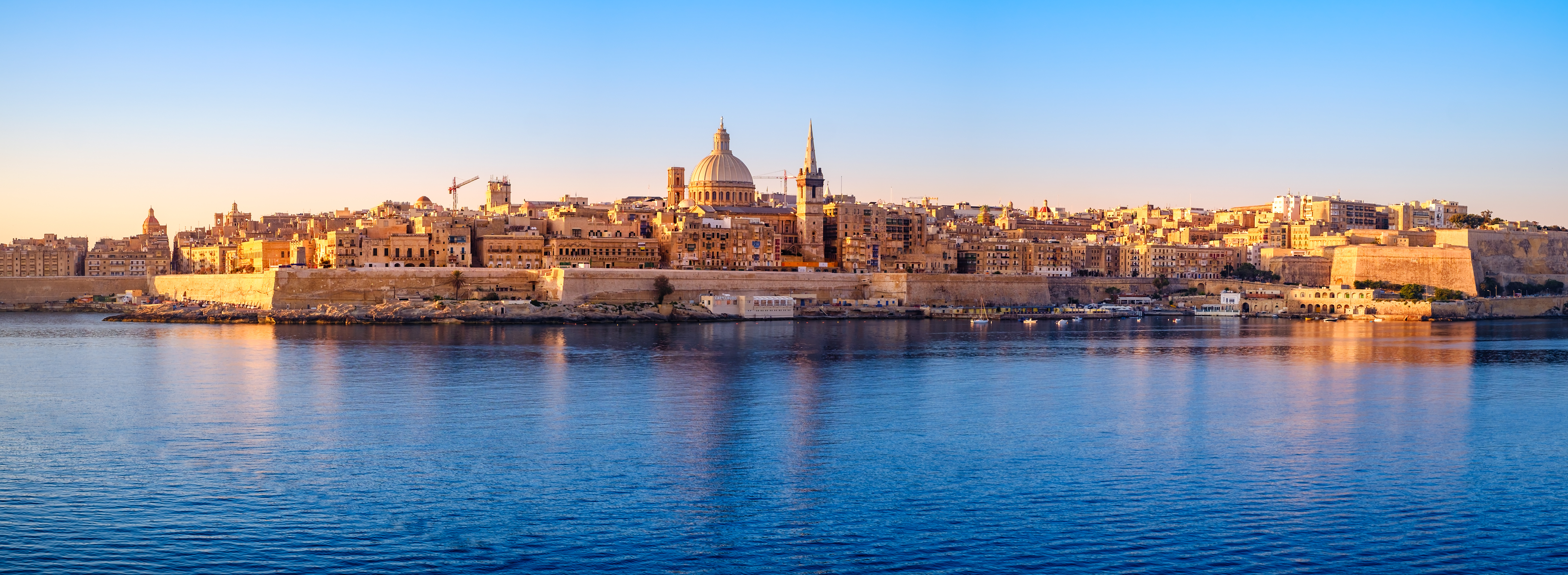
From the Upper Barrakka Gardens, the Grand Harbour appears to explain Valletta. Fortifications follow the contours of the shore, their scale reflecting centuries in which the city’s survival depended on controlling the water below. It is an outward-looking landscape, built to watch approaching ships and withstand attack.
Yet one of the most consequential chapters in Malta’s military history unfolded out of sight.
Beneath the gardens and the Saluting Battery, the Lascaris War Rooms housed a headquarters whose strength depended on concealment. Here, the harbour could be understood without being seen. Reports arrived through communications networks, positions were transferred onto maps, and events taking place across the Mediterranean became information that could be assessed and acted upon. In July 1943, the complex served as an advance Allied headquarters for Operation Husky, the invasion of Sicily.
The contrast is striking. Above ground, Valletta’s defences express power through height, thickness and visibility. Underground, power took another form: the ability to gather information, establish what it meant and communicate a decision before circumstances changed. To visit Lascaris is to encounter that less visible machinery of war. The rooms belong to a wider underground military landscape, and its chronology deserves care. The site’s custodians distinguish the War Headquarters tunnels opened in 1940 from the substantial complex completed for the Sicily operation in May 1943. What visitors encounter is therefore not simply a single bunker created for one dramatic moment but part of a headquarters system that developed as the demands of the war changed.
That distinction matters because the invasion of Sicily did not emerge independently of Malta’s struggle for survival. It followed it.
The island’s position had made it both valuable and vulnerable. A base capable of supporting operations across the central Mediterranean was also a target that Axis forces had powerful reasons to neutralise. The underground headquarters protected the work of command from aerial attack, allowing the island’s military organisation to continue functioning even when the surface was exposed. Within this system, different rooms performed different tasks. A filter room received and assessed radar information. A fighter control room supported the direction of air operations. An anti-aircraft operations room coordinated defensive artillery, while combined operations facilities connected the work of the services. Secure communications allowed sensitive messages to be received and transmitted.
Listed in isolation, these functions can sound administrative. Considered together, they reveal something more demanding: an effort to construct a usable picture from incomplete and constantly changing reports. A radar contact was not yet an explanation. It had to be evaluated alongside other information. A position on a chart was not the event itself, but the latest available account of it. Behind every apparently orderly map lay a difficult relationship between what had happened, what had been reported and what commanders believed was happening now.
This is where the rooms become more interesting than the familiar image of generals leaning over a table.
Their work depended on a chain of people, many far removed from the decisions their information would influence. Observers, radar personnel, communications staff and those maintaining the operational picture made command possible. The senior officer might issue the order, but the quality of that order depended partly on work already completed elsewhere.
Lascaris makes that dependence tangible. It brings attention to the organised labour beneath the language of strategy.
A wartime photograph preserved by the Imperial War Museums shows three British staff officers plotting positions on large wall charts in the underground operations room in Malta during the Sicily landings. There is nothing theatrical about the task. Its significance lies in the connection between those marks on a wall and the forces moving beyond the room.
In July 1943, that connection extended north towards Sicily.
The Allied landings took place during the night of 9 to 10 July, opening a campaign on Axis home territory. For Malta, the operation marked a profound change in emphasis. The island that had fought to remain supplied and operational was now helping support an offensive directed towards the European mainland’s approaches.
Its geography had not changed. The strategic circumstances around it had.
Malta’s airfields could help provide fighter cover for the invasion fleets and landings. Its facilities supported preparations and movements connected with the campaign. Its underground headquarters offered a protected place from which senior commanders could follow and coordinate an operation involving forces spread across a broad theatre.
The temptation is to describe Lascaris as the place from which the invasion was controlled, as though an entire campaign could be reduced to a single room. Its importance is better understood through its connections. The complex formed one node, albeit an exceptional one, within a much larger command structure. Decisions, reports and responsibilities moved between headquarters, ships, airfields and formations in the field. The invasion was not launched from Malta alone, and events on Sicily could not be directed with the neatness suggested by a completed campaign map.
That is precisely why an advance headquarters mattered. It provided a place where the separate demands of a combined operation could be brought into relation.
General Dwight D. Eisenhower used the War Rooms alongside senior Allied commanders associated with the campaign, including Admiral Andrew Cunningham, General Bernard Montgomery and Air Chief Marshal Arthur Tedder. Their responsibilities connected naval movement, land operations and air power, each essential to the operation and each presenting different problems of timing, communication and coordination.
Seen in this light, the underground rooms were not merely a refuge for authority. They were an attempt to make a complex coalition function.
The setting adds another dimension. A headquarters deep inside the rock depended on systems that visitors might otherwise overlook. Mechanical ventilation sustained an enclosed working environment; the site’s custodians identify it as an original feature that still operates. Before intelligence could be interpreted or orders issued, the space itself had to remain habitable. It is a small reminder that strategy rests on material necessities. Air, electricity, communications and maintenance belong to military history just as surely as ships and aircraft do.
There is, however, a moral distance built into any operations room.
On a chart, a coastline becomes a line along which forces advance. A harbour becomes an objective. A town becomes a position to be occupied or bypassed. Such simplification is necessary for command, but it can remove much of what a place contains. Across the water, Sicily was not an empty surface awaiting the fulfilment of an Allied plan. It was an inhabited landscape. The Lascaris exhibition on Operation Husky acknowledges this by addressing civilian suffering, the destruction caused by bombing and fighting, and atrocities committed by Allied and Axis forces. It also examines the successful Axis evacuation from the island, a reminder that the campaign’s outcome was more complicated than a straightforward account of conquest might suggest.
These elements deepen the significance of the headquarters rather than diminish it.
They ask visitors to hold two perspectives at once: the strategic importance of the operation and the human consequences of carrying it out. The maps become more meaningful when we remember what they could not fully show. Malta’s own part in the campaign also extended beyond the presence of famous commanders. The exhibition includes the 231st Independent Infantry Brigade, formed from British regular battalions that had served in Malta’s defence and subsequently took part in the Sicily landings. Its story connects the island’s defensive experience with the forces sent into the next campaign.
That connection prevents July 1943 from becoming an isolated episode of distinguished visitors and historic conferences. It belonged to a longer movement of people, resources and experience through Malta. Nor did the underground complex lose its purpose when the Second World War ended. Its custodians record subsequent use by the Mediterranean Fleet and, from 1967, by NATO as a strategic communications centre associated with monitoring Soviet submarine activity. That role continued until the complex closed in 1977.
The continuity is revealing. Technologies and adversaries changed, but Malta remained valuable as a place from which Mediterranean movements could be followed. The rooms outlasted the conflict that had made them necessary because their underlying purpose remained useful: to receive information, establish a picture and support action beyond the island. Their later restoration, begun by Fondazzjoni Wirt Artna in 2009, gave that hidden history a public audience. The achievement is not simply the preservation of equipment or the recovery of a wartime atmosphere. It is the opportunity to understand how a headquarters worked and to consider the limits as well as the reach of the authority exercised within it.
Back above ground, the Grand Harbour offers its broad, comprehensible view. Water separates one shore from another. Fortifications occupy identifiable positions. Boats can be followed with the eye.
The view is beautiful partly because it feels complete.
Lascaris leaves a different impression. Its significance lies in what could not be seen directly, in the effort required to understand distant events and in the decisions made before the full consequences were known. Beneath Valletta, the Mediterranean became a stream of messages and a changing arrangement of positions on a wall. Beyond those walls, people crossed the water towards an uncertain shore.




